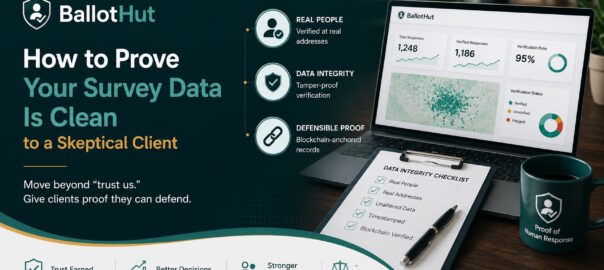
Detection protects your dataset. Proof protects your client relationship. They are not the same thing.
The question that ends client relationships
It rarely arrives as an accusation. It arrives as a polite question in a readout: “How confident are we in this sample?” Or a procurement line: “Describe your data integrity controls.” Or worst, a quiet one: your client’s stakeholder saw the headlines that a third of survey responses are now fraudulent, and now every surprising finding in your report carries an asterisk.
Here is the uncomfortable position most research firms are in: even when the data is clean, they cannot prove it. Internal cleaning logs are not proof; they are your own homework, graded by you. “We removed 12% of responses in QA” does not reassure a client. It tells them 12% of what you fielded was bad, and invites the obvious follow up: how do you know you caught the rest?
What counts as proof, and what does not
Does not count as proof:
- Your panel provider’s quality claims. That is their assertion, passed through you.
- Attention checks and trap questions passed. Modern AI generated responses pass these.
- Internal cleaning documentation. Editable by you, therefore not independent.
- A confident tone in the readout.
Counts as proof:
- Evidence the respondent was a verified, real person, established before they answered.
- Evidence the response was screened at submission against independent data, not just your own rules.
- An independent, tamper evident record showing the dataset has not been altered since collection, verifiable by someone other than you.
The pattern: proof is independent, and it exists at every stage, not just at cleanup.
The three questions your client is really asking
1. “Were these real people?” Answer it with identity, not inference. KYC verification before a respondent answers means you can say “every response in this dataset came from a verified identity,” which is a categorically different sentence than “we screen for bots.” The research industry’s open secret is that most vendors cannot verify everyone; saying you can, and showing it, separates you immediately.
2. “Did anything fake get through?” Answer it with screening at the gate: CAPTCHA plus validation against an independent national address database at the moment of submission. Fraud stopped at entry never needs to be found in cleaning, and your cleaning rate becomes a small number you are happy to share.
3. “Has the data been touched since?” Answer it with an immutable record. When the completed responses are written to the XRP Ledger after submission, the dataset becomes tamper evident: anyone, including your client’s own analyst, can confirm it matches what was collected. You are no longer asking to be trusted; you are handing over the means to verify.
How to put this in front of a client
A simple integrity statement at the front of the report, three lines:
- All responses in this study came from KYC verified identities.
- Submissions were screened in real time against [controls], with a [X]% rejection rate at the gate.
- The completed dataset is recorded immutably on the XRP Ledger and is independently auditable; the verification reference is available on request.
Then watch what happens in the room. The data quality conversation, which used to be a defensive moment, becomes a selling moment. You are the firm that proves it.
Try it on one study
The fastest way to experience the difference is a paid pilot on a single project: your study, fielded with all three layers on, with a before and after you can show your client. Details at ballothut.com.
Tracy Wehringer CMO, BallotHut