The category for how BallotHut verifies that a response or a vote is real, after it is submitted. Articles here explain post-submission verification on the XRP Ledger, why CAPTCHA and pre-submission checks alone are no longer enough, and how cryptographic verification creates an audit trail that survey buyers, election officials, and regulators can actually trust. Read this section if you want to understand the science of response integrity, the limits of legacy fraud detection, and what “verified” means when it is provable on a public ledger.
Five separate developments this year, from five sets of people who do not work together. Read individually, each is a story. Read together, they describe one shift, and it is not the one most coverage is reporting.
The year in five findings
January, the journals. Nature reported on an AI chatbot built to be indistinguishable from real survey participants, already present in the online panels thousands of studies depend on. Weeks later, Cambridge researchers made the follow-on point: fraud detection designed to catch human cheaters is not the same instrument as one that catches AI.
May, the establishment. Pew Research Center published a piece asking whether AI and bogus respondents threaten polling’s future. That is not a methods footnote. It is the most trusted name in public polling raising the question in public, about its own field.
The insiders. Industry surveys of researchers found near-universal AI adoption in the workflow alongside deep skepticism about AI in the respondent’s seat, and, more concerning, that most organizations have no formal policy governing synthetic-respondent tools at all. Researchers trust AI everywhere except where it answers the question.
June, the public test. CloudResearch, with an independent MIT team as judge, put $50,000 behind an open challenge: build an AI agent that gets past current detection and claim the money. 500 verified humans and 500 AI agents are mixed into a live survey; detection rates and false-positive rates are published openly. It is a bounty, not a benchmark, and the false positives are as much the point as the catches.
May, outside research entirely. Proof joined the FIDO Alliance to help define how an AI agent’s actions get cryptographically bound to a verified human identity, and World argued that proof of human is now infrastructure rather than advice. OpenAI, Google, and Mastercard are all contributing to the same standards work.
The through-line
Every one of these is the same question in a different jacket: how do you know a person was on the other end? Journals asked it about panels, Pew asked it about polls, and payments infrastructure is now asking it about transactions.
The distinction the whole year turns on
Detection looks at a response that has already arrived and estimates how likely it is to have come from a person. It is inference, and it is inference against an opponent whose entire purpose is to look unremarkable. It is genuinely good; behavioral signals catch a great deal, but it produces a probability, and probabilities degrade as the adversary improves.
Verification answers a different question. Not “does this look human?” but “can we show a real person at a real address sent it?” That produces a record rather than a score. The two are complementary: detection narrows the field; verification is what survives scrutiny.
“Verify respondents are real people, don’t just detect fraud after the fact.” – Tracy A. Wehringer, MBA, CMO, BallotHut.com
Reach out to learn more about a pilot today
See how proof of human response works on your next study.
Sources: Nature (Phillips, Jan 2026); Panizza, Kyrychenko & Roozenbeek (Feb 2026); Pew Research Center (May 2026); User Interviews / Mecke, State of Synthetic Users (2026); Rival Group, Market Research Trends 2026; CloudResearch × MIT, “The Bot Olympics” (June 2026); World, “A Safer Internet Starts with Proof of Human” (May 2026); Proof / FIDO Alliance (May 2026).
A plain-English explanation of the challenge CloudResearch and MIT put in front of the research industry, what the prize money is really for, and what it does and doesn’t prove.
The short version
The $50,000 is not a research grant and not a prize pool split between detection vendors. It is a bounty. CloudResearch has offered $50,000 to anyone who can build an AI agent that gets through its fraud-detection systems without being caught, with an independent MIT team acting as judge and publishing the results.
In other words, the company is paying people to try to beat it in public. If someone collects the money, the industry learns exactly how current detection fails. If nobody collects it, that unclaimed money becomes the evidence.
HOW THE TEST IS STRUCTURED
500 verified humans and 500 AI agents are randomly mixed into a live survey.
Detection tools try to sort one group from the other.
MIT publishes the detection rates, the false-positive rates, and the full results openly.
Why a bounty instead of a study
The format is borrowed from James Randi’s $1 million paranormal challenge, which stood unclaimed for decades and became the strongest available evidence that the abilities it tested for did not exist. A standing, well-publicized prize is a harder test than an internal benchmark, because anyone in the world is invited to break the thing; including the people with the most to gain from breaking it.
The detail that deserves more attention than the prize money is the publication of false positives. A detection system can look excellent by flagging aggressively, at the cost of throwing out real respondents. Publishing both numbers, adjudicated by a third party, is the part that makes the exercise useful to buyers rather than to marketing departments.
What it proves, and what it doesn’t
It is worth being precise here, because the headline invites overstatement in both directions.
CloudResearch’s own position is that AI agents are detectable today through behavioral signals, cursor movement, timing, interaction patterns, rather than through anything visible in the answers themselves. Their argument is also that AI agents remain a small share of the actual data-quality problem, and that human fraud (click farms, professional survey takers, LLM-assisted respondents) is still the larger threat. The Bot Olympics is aimed at the next question: what happens when the agents get better.
So, the challenge does not prove that detection has failed. It proves something more uncomfortable and more useful: that detection is now a moving target that has to be re-tested continuously, in public, against attackers who are actively trying to defeat it. Nobody in the industry treats a one-time certification as sufficient anymore.
Why this matters if you buy research
Every question the Bot Olympics asks is a question about inference. Detection looks at a completed response and estimates how likely it is to have come from a person. It is a probability judgment, made after the fact, against an adversary whose whole purpose is to look ordinary.
Verification asks something different. Not “does this response look human?” but “can we show that a real person at a real address sent it?” Those two questions can be answered on the same dataset, and they fail in different ways, which is exactly why they belong together rather than in competition.
BallotHut sits on the verification side of that line. When a response comes in, we confirm it against a real person at a real address, so the record carries proof rather than a probability score. Detection narrows the field. Verification is what you can put in front of a client, a regulator, or a reviewer.
The question worth asking your provider: Not “do you screen for bots?” everyone says yes. Ask what their false-positive rate is, who measured it, and when it was last tested by someone who does not work for them.
Sources: CloudResearch, “The Bot Olympics: A $50K Test of AI Survey Fraud Detection” (June 2026); CloudResearch, “The Worst-Kept Secret in Market Research” (June 2026); Quirk’s Chicago session, “The ‘Bot Olympics’ approach to catching AI agents” (April 2026).
Detection protects your dataset. Proof protects your client relationship. They are not the same thing.
The question that ends client relationships
It rarely arrives as an accusation. It arrives as a polite question in a readout: “How confident are we in this sample?” Or a procurement line: “Describe your data integrity controls.” Or worst, a quiet one: your client’s stakeholder saw the headlines that a third of survey responses are now fraudulent, and now every surprising finding in your report carries an asterisk.
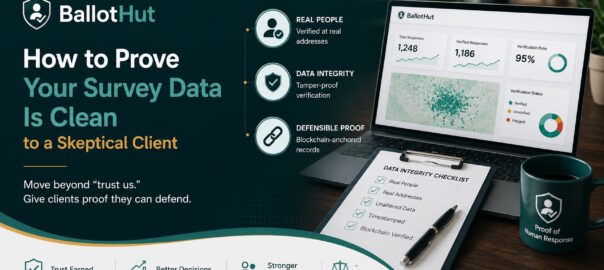
Here is the uncomfortable position most research firms are in: even when the data is clean, they cannot prove it. Internal cleaning logs are not proof; they are your own homework, graded by you. “We removed 12% of responses in QA” does not reassure a client. It tells them 12% of what you fielded was bad, and invites the obvious follow up: how do you know you caught the rest?
What counts as proof, and what does not
Does not count as proof:
Your panel provider’s quality claims. That is their assertion, passed through you.
Attention checks and trap questions passed. Modern AI generated responses pass these.
Internal cleaning documentation. Editable by you, therefore not independent.
A confident tone in the readout.
Counts as proof:
Evidence the respondent was a verified, real person, established before they answered.
Evidence the response was screened at submission against independent data, not just your own rules.
An independent, tamper evident record showing the dataset has not been altered since collection, verifiable by someone other than you.
The pattern: proof is independent, and it exists at every stage, not just at cleanup.
The three questions your client is really asking
1. “Were these real people?” Answer it with identity, not inference. KYC verification before a respondent answers means you can say “every response in this dataset came from a verified identity,” which is a categorically different sentence than “we screen for bots.” The research industry’s open secret is that most vendors cannot verify everyone; saying you can, and showing it, separates you immediately.
2. “Did anything fake get through?” Answer it with screening at the gate: CAPTCHA plus validation against an independent national address database at the moment of submission. Fraud stopped at entry never needs to be found in cleaning, and your cleaning rate becomes a small number you are happy to share.
3. “Has the data been touched since?” Answer it with an immutable record. When the completed responses are written to the XRP Ledger after submission, the dataset becomes tamper evident: anyone, including your client’s own analyst, can confirm it matches what was collected. You are no longer asking to be trusted; you are handing over the means to verify.
How to put this in front of a client
A simple integrity statement at the front of the report, three lines:
All responses in this study came from KYC verified identities.
Submissions were screened in real time against [controls], with a [X]% rejection rate at the gate.
The completed dataset is recorded immutably on the XRP Ledger and is independently auditable; the verification reference is available on request.
Then watch what happens in the room. The data quality conversation, which used to be a defensive moment, becomes a selling moment. You are the firm that proves it.
Try it on one study
The fastest way to experience the difference is a paid pilot on a single project: your study, fielded with all three layers on, with a before and after you can show your client. Details at ballothut.com.
How AI Broke Survey Research, And What to Do About it.
by Tracy A. Wehringer, CMO
Executive Summary
Survey research is facing an existential crisis. The same AI technologies transforming business are simultaneously destroying the integrity of survey data. In 2026, nearly one-third of all survey responses are fraudulent, and traditional fraud detection methods catch almost none of them.
This report examines the scope of the AI survey fraud epidemic, explains why conventional defenses have failed, and outlines the emerging solutions that can restore trust in survey data.
Key Findings
31% of raw survey responses now contain fraud, up from an estimated 10-15% in 2022
As few as 10-52 fake responses can flip poll results in political and market research
38% of collected survey data is now discarded due to suspected fraud, wasting research budgets
57% of document fraud is now AI-generated, a 244% year-over-year increase
The Bottom Line: Traditional fraud detection methods were designed for human bad actors. They are fundamentally incapable of stopping AI-powered fraud. A new approach is required: verifying respondent identity after survey completion.
The Scale of the Problem
Survey fraud is not new. Researchers have battled fraudulent responses for decades. But generative AI has fundamentally changed the economics and sophistication of fraud, transforming a manageable nuisance into a crisis threatening the validity of all survey-based research.
This figure represents a dramatic acceleration. Industry estimates from 2020-2022 placed fraud rates at 10-15% of responses. The introduction of ChatGPT in late 2022 and subsequent large language models created an inflection point, enabling fraud at scale with unprecedented sophistication.
The Academic Research Crisis
Academic researchers have been hit particularly hard. A 2023 study published in Wiley’s Applied Economic Perspectives and Policy documented an extreme case: 96% of responses to an online survey were identified as fraudulent.
The researchers noted that fraudulent respondents had become indistinguishable from legitimate participants using traditional screening methods. Standard academic practices, university email verification, attention checks, and response time analysis, proved ineffective against AI-powered fraud.
Market Research Under Siege
The market research industry, valued at over $80 billion globally, faces a credibility crisis. According to IPQS (IP Quality Score), 20% of market research data submitted to clients contains fraudulent responses, responses that passed all quality checks before delivery.
This has cascading effects across industries:
Companies making product decisions based on corrupted data
Political campaigns misreading voter sentiment
Healthcare organizations drawing incorrect conclusions about patient experiences
HR departments making policy changes based on fraudulent employee feedback
Why Traditional Defenses Fail
The survey industry has relied on a standard toolkit of fraud prevention measures for over a decade. In the age of generative AI, every single one of these defenses has been neutralized.
The 99.8% Problem
A landmark 2025 study from Dartmouth College tested AI bots against standard survey quality measures. The results were devastating for the industry:
The bots successfully defeated security checks and exhibited human-like response timing. Traditional quality indicators, straight-lining detection, speeder flags, gibberish filters, were essentially useless.
Defense-by-Defense Breakdown
Response Time Analysis
Bot operators have adapted. Modern survey bots incorporate randomized delays, simulate reading time proportional to question length, and even mimic human patterns like slower responses on complex questions. The Dartmouth study found bot response patterns statistically identical to human participants.
Email and IP Verification
Fraudsters operate with thousands of unique email addresses and rotate through residential IP pools. A single bot operator can present as thousands of distinct individuals across different geographic locations.
Fraud Defense Effectiveness: Pre-AI vs. Post-AI
The Economics of AI Survey Fraud
Understanding why fraud has exploded requires examining the economic incentives. AI has fundamentally altered the cost-benefit calculation, making survey fraud extraordinarily profitable.
The $0.05 vs. $1.50 Gap
The Dartmouth research documented the core economic driver:
Human Respondent
AI Bot Operator
$1.50 average payout
$0.05 cost per response
10-15 minutes per survey
30 seconds per survey
Limited daily capacity
Thousands daily
Geographic constraints
Global operation
A single bot operator running automated scripts can complete thousands of surveys daily. At a 30x profit margin per response and near-zero marginal cost to scale, the economic incentive is overwhelming.
The Fraud Industry Infrastructure
Survey fraud has evolved from individual bad actors to an organized industry with sophisticated infrastructure:
Bot-as-a-Service platforms offering survey completion at scale
Residential proxy networks masking bot traffic as legitimate users
AI model fine-tuning specifically for survey response generation
Survey fraud is not an abstract data quality issue. Corrupted survey data leads to real-world decisions with significant consequences.
Political Polling Manipulation
The Dartmouth study demonstrated that remarkably small numbers of fraudulent responses can alter research outcomes:
In close elections or contested policy debates, this represents a serious vulnerability. Bad actors can influence perceived public opinion at minimal cost, potentially affecting media coverage, campaign strategy, and policy decisions.
Business Intelligence Failures
Companies relying on customer feedback surveys, employee engagement studies, and market research face corrupted intelligence:
Product teams launching features based on fake user preferences
HR departments misreading employee sentiment and engagement
Executive decisions based on fundamentally flawed data
M&A due diligence compromised by unreliable market research
The Hidden Cost: Data Waste
Research organizations have responded to the fraud epidemic by discarding suspicious data; often far more than necessary due to inability to distinguish real from fake:
This represents massive waste: research budgets hemorrhaging value, extended project timelines, and reduced sample sizes that compromise statistical validity.
The True Cost of Survey Fraud (per $100K research project): • Data collection cost: $100,000 • Usable data after fraud screening: 62% ($62,000 value) • Discarded data: 38% ($38,000 wasted) • Additional collection to reach target n: +$15,000-25,000 • Extended timeline: 2-4 weeks delay Total impact: 40-60% budget inefficiency
The Broader AI Fraud Context
Survey fraud exists within a larger epidemic of AI-generated deception affecting all forms of digital verification and authentication.
Document Fraud Explosion
The Entrust Cybersecurity Institute’s 2025 Identity Fraud Report documented the acceleration:
Deepfakes, synthetic identities, and AI-generated documents have moved from theoretical concerns to operational realities. Organizations across sectors are confronting the same fundamental challenge: how do you verify that a human is real?
The Rise of Proof-of-Humanity
This crisis has spawned a new category of solutions focused on verifying human identity in digital interactions. The market validation is significant:
Market Indicator
Value/Projection
Humanity Protocol Valuation
$1.1B (Jan 2025)
Humanity Protocol Funding
$50M raised
Digital ID Verification Market (2034)
$27B+
Decentralized Identity Market (2035)
$620B+
Enterprises Considering Blockchain for ID
65%
Digital ID Apps Projected (2030)
6.2 billion
The Path Forward
The survey industry cannot defend against AI fraud using pre-AI tools. A new approach is required—one that verifies respondent authenticity at a fundamental level rather than attempting to detect fraud after the fact.
From Fraud Detection to Identity Verification
The paradigm shift required is moving from probabilistic fraud detection to deterministic identity verification:
Old Model: Fraud Detection
New Model: Identity Verification
Responses collected
Verified survey deployed
Fraud analysis (probabilistic)
Responses collected
Maybe valid data
Definitively valid data
The critical insight: verification must happen before or during survey completion—not after. Once a fraudulent response is in your dataset, you’re guessing about which responses to keep.
Key Components of Next-Generation Verification
Address-Based Identity
Verifying that a respondent exists at a real physical address provides a foundation of authenticity that AI cannot easily fabricate. When combined with a comprehensive address database, this creates a verification layer tied to the physical world. An AI bot cannot claim to live at 123 Main Street if that address can be validated against 80M+ verified residential addresses.
Blockchain-Backed Verification
Immutable verification records prevent tampering and create auditable proof of respondent authenticity. Each verified response can be traced to its verification event, providing defensible data integrity.
Geographic Intelligence
Beyond simple verification, understanding the geographic distribution of responses provides additional validity signals. For government and community surveys, this enables verification that respondents actually live in the jurisdiction they’re providing feedback about.
Conclusion
The survey industry stands at a crossroads. The AI technologies that have revolutionized countless industries have simultaneously undermined the foundational assumption of survey research: that responses come from real humans sharing genuine opinions.
The statistics are stark:
31% fraud rates in raw survey data
99.8% of AI bots passing traditional quality checks
38% of research budgets wasted on unusable data
10-52 fake responses sufficient to flip poll results
Traditional defenses have failed. The gap between fraud sophistication and detection capability widens daily. Organizations continuing to rely on attention checks, and response time analysis are not protecting their data, they’re providing themselves false confidence while fraud passes undetected.
But this crisis also presents an opportunity. Organizations that adopt next-generation verification, moving from fraud detection to identity verification, will possess a significant competitive advantage: data they can actually trust.
The question is no longer whether to address survey fraud, but how quickly organizations can implement solutions before the credibility of their research is irreparably compromised. The future of survey research belongs to organizations that can prove their data comes from verified humans, not those hoping their fraud filters catch what AI throws at them.
References
Survey Fraud Research
Research Defender. (2024). Survey fraud detection benchmarks.
Dartmouth College. (2025). AI bots and survey quality: A comprehensive analysis. Study Finds.
Kennedy, A., Barkley, B., et al. (2023). Battling bots: Experiences and strategies to mitigate fraudulent responses in online surveys. Applied Economic Perspectives and Policy, Wiley.
IPQS – IP Quality Score. (2024). Market research fraud analysis.
MRS – Market Research Society. (2023). AI-generated response trends in market research.
Greenbook. (2024). Online Survey Frauds in Market Research: Challenges and Solutions.
CHEQ. (2024). Survey Bots: How They Manipulate Data and Skew Results.
Tracy A. Wehringer, MBA serves as the fractional Chief Marketing Officer at BallotHut. With extensive C-suite advisory experience including Global 500 clients, Tracy brings deep expertise in revenue marketing, go-to-market strategy, and emerging technology positioning.
About BallotHut
BallotHut is a Proof of Human Response platform that verifies survey respondents are real people at real addresses using blockchain-backed authentication.Built on XRPL technology with access to an 80M+ National Address Database, BallotHut integrates with existing survey platforms to provide the verification layer organizations need to trust their data. ballothut.com
A quick diagnostic checklist for research and insights teams. If three or more sound familiar, keep reading.
Fraud rarely announces itself. With roughly a third of survey attempts now fraudulent and AI generated answers passing standard quality checks, the signs are subtle, statistical, and easy to rationalize away. Here are twelve worth taking seriously.
1. Your open ends got better. Suspiciously better. Fluent, on topic, well-structured answers at scale are now more likely to be a language model than an unusually articulate panel. The old tells (gibberish, copy paste) are gone; eloquence is the new red flag.
2. Completion times cluster too tightly. Real humans are messy: some race, some wander off and return. When a large share of completes land in a narrow time band, automation or scripted farms are the likelier explanation.
3. Straight lining has gotten smarter. Instead of all 5s, you see plausible variation that never quite contradicts itself. Sophisticated fraud mimics attentiveness; check whether grid answers correlate too perfectly with each other.
4. Incidence rates do not match reality. When 30% of your general population sample claims to own a boat, manage enterprise IT budgets, or have a rare condition, fraudsters are qualifying into your highest paying screeners.
5. Demographics shift between waves. A tracker whose respondent profile drifts wave to wave without a real world reason often means the fraudulent share of your panel is changing underneath you.
6. Geography and IP do not line up. Respondents claiming one location while submitting from another, or clusters of completes from data center IP ranges, point to farms and proxies.
7. Your cleaning rate keeps creeping up. If you removed 5% of completes two years ago and remove 15% now, the question is not whether fraud is rising; it is how much is still getting through, since cleanup only catches what your rules can see.
8. Trap questions stopped trapping. When attention check failure rates fall while everything else looks worse, the fraud has learned your checks. AI assisted respondents pass traps designed for careless humans.
9. Surprising findings keep failing to replicate. Fraud injects noise that masquerades as insight. If your interesting subgroup differences evaporate on re fielding, contamination is a prime suspect.
10. The same “person” keeps coming back. Matching response patterns, device fingerprints, or open end phrasing across supposedly different respondents means duplicates or a persona farm.
11. Your panel provider cannot answer the identity question. Ask directly: what share of these respondents passed identity verification, and by what method? If the answer is a quality score rather than a verification method, identity is unverified.
12. A client asked, and you got defensive. The clearest sign of all. If “how do we know these are real people” produces discomfort instead of a document, your process has a proof gap regardless of how clean the data actually is.
What to do with your count
0 to 2 signs: Stay vigilant; your exposure is likely moderate. Your next move is proof: being able to demonstrate integrity, not just maintain it.
3 to 5 signs: You have a live problem. Take our Survey Fraud Risk Scorecard to locate exactly where fraud is entering: at identity, at submission, or after.
6 or more: Your datasets are materially contaminated, and cleaning alone will not fix it, because cleaning only catches what your rules already know to look for. The fix is structural: verify identity before anyone answers, screen at submission, and keep a tamper evident record after.
That three layer structure is what BallotHut does: KYC verified identities, CAPTCHA plus 80M+ address database screening at submission, and an immutable post submission record on the XRP Ledger. The fastest way to see the difference is a paid pilot on one of your own studies.
We make it impossible for your opinion to be misrepresented. You Deserve to Be Heard – Make Your Voice Count With BallotHut!
BallotHut empowers you to share your opinions on topics that matter. Whether you’re looking to earn rewards or seeking reliable insights as a client, we offer a secure platform powered by blockchain technology for transparency and data integrity.
Why Join BallotHut?
Key Benefits for Individuals
Earn Rewards: Receive rewards for your input when offered by survey creators.
Influence Change: Participate in surveys that impact decisions.
Data Privacy Guaranteed: Your responses are protected with blockchain-powered confidentiality.
Flexible Participation: Sign up and subscribe to topics that matter to you anytime!
Benefits for Clients
Need Reliable Data? Choose BallotHut for Real, Impactful Insights.
BallotHut’s platform guarantees accurate, fraud-free survey results with the power of blockchain technology. Target specific locations, integrate seamlessly with popular survey tools, and protect participant privacy—all while gathering valuable, honest insights.
Our Technology
Trustworthy, Transparent, and Fraud-Free Data Collection
Our blockchain-powered platform ensures that each survey is secure, transparent, and tamper-proof. By preventing survey fraud and safeguarding respondent confidentiality, we provide high-quality data that you can trust. With BallotHut, every opinion is captured accurately, making your data work smarter.
Ready to Get Started?
Join BallotHut Today and Make Your Opinion Count!
Unlock the full potential of your voice. Whether you’re here to participate in rewarding surveys or collect meaningful data, BallotHut provides the tools and integrity to make every response matter. Sign up now and be part of a community where opinions drive real change.